How we built a contract intelligence service that takes a raw PDF contract, extracts its structure with Reducto, classifies each section with an LLM, and produces reusable Jinja templates — all orchestrated through SQS workers with heartbeat-based visibility extension.
Table of contents
Open Table of contents
The problem
Real-estate agencies in Portugal deal with dozens of contract types — rental agreements, purchase contracts, promissory contracts. Each one follows a similar structure but varies in party details, clauses, and conditions. Drafting them manually is slow, error-prone, and doesn’t scale.
We needed a system that could:
- Ingest a source contract (PDF/DOCX) and understand its structure
- Analyze each section to determine if it’s static boilerplate, parameterized, conditional, or needs AI drafting
- Templatize the analyzed sections into reusable Jinja templates
- Generate new contracts by filling templates with CRM data
Architecture overview
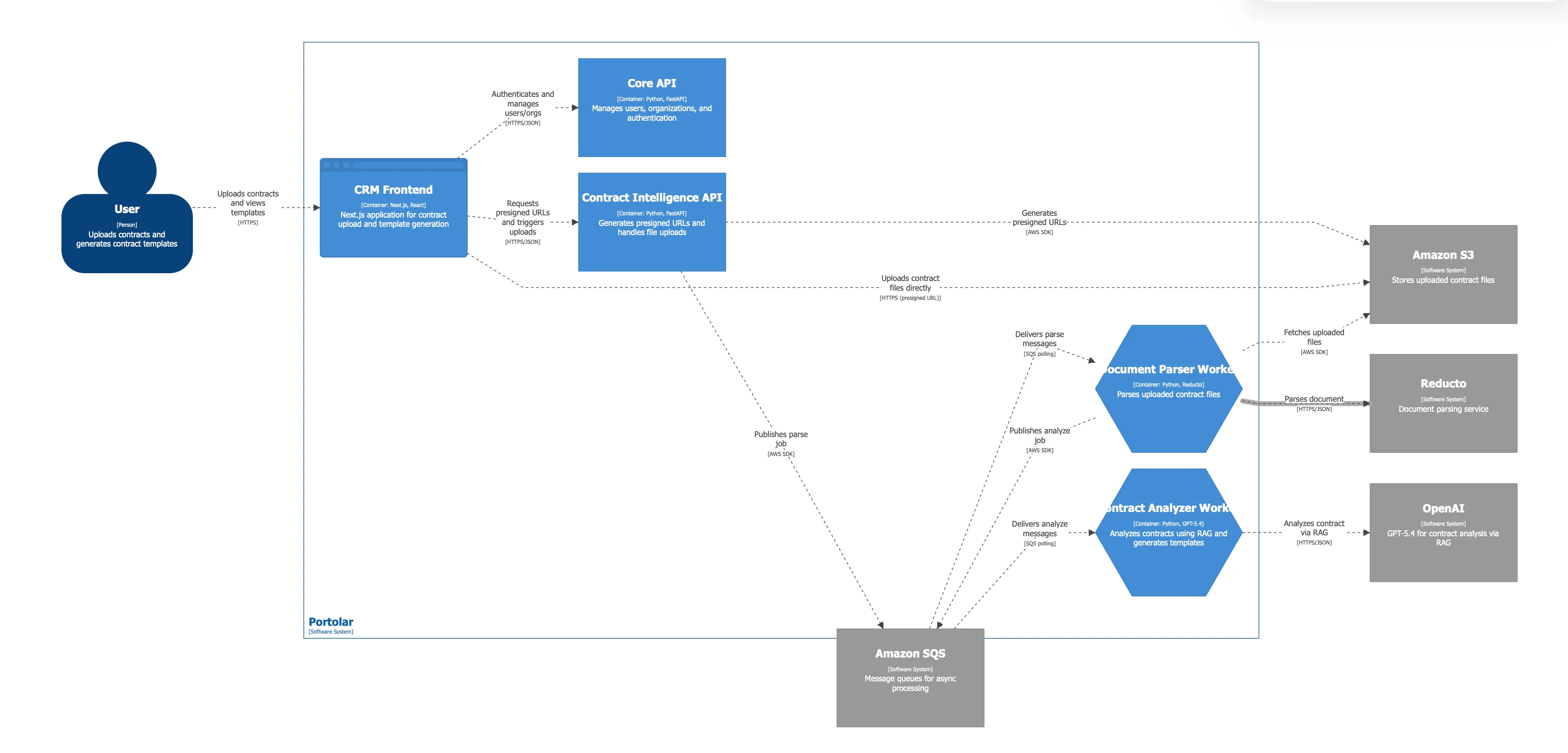
The service follows hexagonal architecture (ports & adapters) with async Python, FastAPI, and SQS-based workers.
The full pipeline flows through five phases:
Project structure
src/contract_intelligence/
├── domain/
│   ├── entities/         # Pure dataclasses, state machines
│   ├── ports/            # Protocol interfaces
│   └── exceptions.py
├── application/
│   ├── config.py         # Settings (env vars)
│   ├── dtos/             # Pydantic request/response models
│   └── services/         # Use cases (ingestion, analysis, review)
├── adapters/
│   ├── inbound/
│   │   ├── api/          # FastAPI routes
│   │   └── workers/      # SQS consumers
│   └── outbound/
│       ├── llm/          # LangChain + OpenAI
│       ├── reducto/      # Document parsing
│       ├── persistence/  # SQLAlchemy repos
│       ├── storage/      # S3
│       └── sqs.py        # Message producer/consumer
└── entrypoints/
    ├── api.py            # FastAPI app factory
    └── worker.py         # Worker CLI
Every external dependency is behind a Protocol interface. The domain layer has zero imports from frameworks or SDKs.
Phase 1: Document ingestion
When a user uploads a contract PDF, the API stores it in S3, computes a SHA-256 hash for deduplication, and publishes an SQS message.
The IngestionWorker picks it up and runs the document through Reducto — a document intelligence pipeline that handles OCR, layout detection, section splitting, and field extraction in a single call.
Domain model
The SourceDocument entity tracks the full lifecycle with an explicit state machine:
class UploadStatus(StrEnum):
    UPLOADED = "uploaded"
    PARSED = "parsed"
    EXTRACTED = "extracted"
    ANALYZED = "analyzed"
    FAILED = "failed"

_UPLOAD_TRANSITIONS: dict[UploadStatus, set[UploadStatus]] = {
    UploadStatus.UPLOADED: {UploadStatus.PARSED, UploadStatus.EXTRACTED, UploadStatus.FAILED},
    UploadStatus.PARSED: {UploadStatus.EXTRACTED, UploadStatus.FAILED},
    UploadStatus.EXTRACTED: {UploadStatus.ANALYZED, UploadStatus.FAILED},
    UploadStatus.ANALYZED: {UploadStatus.FAILED},
    UploadStatus.FAILED: set(),
}

def _validate_transition(current, target, transitions, entity_name):
    allowed = transitions.get(current, set())
    if target not in allowed:
        raise InvalidStatusTransitionError(
            f"{entity_name} cannot transition from {current} to {target}"
        )
Every status change goes through _validate_transition. This prevents impossible states like jumping from UPLOADED directly to ANALYZED.
The Reducto port
External services are defined as Protocol interfaces in the domain layer:
@dataclass
class ParsedSection:
    sort_order: int
    title: str | None
    page_start: int | None
    page_end: int | None
    content: str

@dataclass
class ExtractedField:
    field_key: str
    field_value: Any
    source_text: str | None = None
    page_number: int | None = None
    confidence: float | None = None

@dataclass
class PipelineResult:
    job_id: str
    parse_response_json: dict
    extract_response_json: dict
    split_response_json: dict | None
    sections: list[ParsedSection] = field(default_factory=list)
    extracted_fields: list[ExtractedField] = field(default_factory=list)

class ReductoPort(Protocol):
    async def run_pipeline(self, document_input: str, pipeline_id: str) -> PipelineResult: ...
    async def upload_file(self, data: bytes, filename: str) -> str: ...
The domain defines what it needs (sections, fields, confidence scores). The adapter decides how (Reducto SDK, presigned URLs, timeouts).
Ingestion service
The IngestionService orchestrates the full parse-and-extract flow:
class IngestionService:
    def __init__(
        self,
        repo: SourceDocumentRepository,
        section_repo: SourceSectionRepository,
        storage: FileStoragePort,
        reducto: ReductoPort,
        settings: Settings,
        publisher: MessagePublisherPort | None = None,
    ) -> None:
        self._repo = repo
        self._section_repo = section_repo
        self._storage = storage
        self._reducto = reducto
        self._settings = settings
        self._publisher = publisher

    async def ingest(self, document_id: UUID) -> IngestResult:
        document = await self._repo.get_by_id(document_id)
        if not document:
            raise SourceDocumentNotFoundError(document_id)

        # Idempotency guard: only process documents in UPLOADED state
        if document.upload_status != UploadStatus.UPLOADED:
            return IngestResult(parse_run_id=None, extraction_run_id=None,
                                sections_created=0, fields_extracted=0)

        parse_run = SourceParseRun.start(source_document_id=document.id)
        parse_run = await self._repo.save_parse_run(parse_run)

        try:
            # Dev: download from LocalStack, upload to Reducto
            # Prod: generate S3 presigned URL
            if self._settings.aws_endpoint_url:
                storage_key = document.storage_url.replace(
                    f"s3://{self._settings.s3_bucket_name}/", ""
                )
                data = await self._storage.download(storage_key)
                document_input = await self._reducto.upload_file(data, document.filename)
            else:
                storage_key = document.storage_url.replace(
                    f"s3://{self._settings.s3_bucket_name}/", ""
                )
                document_input = await self._storage.get_presigned_url(storage_key)

            # Run Reducto pipeline
            result = await self._reducto.run_pipeline(
                document_input, self._settings.reducto_pipeline_id
            )

            now = datetime.now(UTC)
            parse_run.mark_succeeded(completed_at=now, provider_job_id=result.job_id,
                                     response_json=result.parse_response_json)
            await self._repo.update_parse_run(parse_run)

            document.mark_parsed()
            await self._repo.update_status(document.id, document.upload_status)

            # Create sections and field evidence
            for parsed_section in result.sections:
                section = SourceSection.from_parsed(document.id, parsed_section)
                await self._section_repo.save_section(section)

            extraction_run = SourceExtractionRun.create_succeeded(
                source_document_id=document.id,
                schema_version="pipeline-v1",
                extraction_schema_json={"pipeline_id": self._settings.reducto_pipeline_id},
                completed_at=now, provider_job_id=result.job_id,
                result_json=result.extract_response_json,
            )
            extraction_run = await self._repo.save_extraction_run(extraction_run)

            for extracted_field in result.extracted_fields:
                evidence = SourceFieldEvidence.from_extracted(
                    extraction_run.id, extracted_field
                )
                await self._repo.save_field_evidence(evidence)

            document.mark_extracted()
            await self._repo.update_status(document.id, document.upload_status)

            # Publish analysis event for the next phase
            if self._publisher and self._settings.sqs_analysis_queue_url:
                await self._publisher.publish(
                    self._settings.sqs_analysis_queue_url,
                    {"document_id": str(document.id)},
                )

            return IngestResult(
                parse_run_id=parse_run.id,
                extraction_run_id=extraction_run.id,
                sections_created=len(result.sections),
                fields_extracted=len(result.extracted_fields),
            )
        except Exception:
            parse_run.mark_failed(completed_at=datetime.now(UTC))
            await self._repo.update_parse_run(parse_run)
            raise
Key design decisions:
- Idempotency guard — if the document is already past
UPLOADED, we skip. SQS can deliver messages more than once. - Dev/prod path split — LocalStack doesn’t support presigned URLs that Reducto can reach, so in dev we download and re-upload.
- Error handling — on failure, the parse run is marked
FAILEDbut the document staysUPLOADEDso SQS retry can pick it up again.
Phase 2: LLM section analysis
Once a document is extracted, the analysis worker classifies each section using GPT-5.4 with LangChain structured output.
Structured output schema
We use Pydantic models as the LLM’s response schema. LangChain’s with_structured_output() enforces the schema at the API level — the LLM must return valid JSON matching these types:
class SectionAnalysisOutput(BaseModel):
    model_config = ConfigDict(extra="forbid")

    source_section_id: uuid.UUID = Field(
        description="The UUID of the source section being analysed."
    )
    section_type: SectionType = Field(
        description="Classification of the section content type."
    )
    reasoning: str = Field(
        description="Explanation of why this classification was chosen."
    )
    risk_level: RiskLevel = Field(
        description="Risk level associated with incorrect rendering."
    )
    recommended_strategy: RecommendedStrategy = Field(
        description="Recommended rendering strategy for template generation."
    )
    references: list[AnalysisReference] = Field(
        default=[],
        description="Fields and conditions referenced by this section."
    )

class SourceSectionAnalysisBatchOutput(BaseModel):
    model_config = ConfigDict(extra="forbid")

    analyses: list[SectionAnalysisOutput] = Field(
        description="Analysis results for each section in the batch."
    )
The classification values are domain enums:
- section_type:
static(boilerplate),parameterized(has placeholders),conditional(clause depends on conditions),generative(needs AI drafting) - risk_level:
low,medium,high - recommended_strategy:
literal(copy verbatim),template(Jinja with fields),template_variant(Jinja with conditionals),ai_draft(LLM generates)
The LLM client
SYSTEM_PROMPT = """\
You are an expert analyst of Portuguese real-estate contracts.
You receive a list of sections extracted from a source contract document,
together with structured field evidence already extracted from that document.

For each section you must determine:
1. **section_type** – classify the section content:
   - `static`: boilerplate that rarely changes across contracts of the same type.
   - `parameterized`: contains placeholders that vary per contract (names, dates, amounts).
   - `conditional`: included only when certain conditions apply (e.g. guarantor clause).
   - `generative`: needs AI drafting because the language varies significantly.
2. **reasoning** – a short explanation of why you chose this classification.
3. **risk_level** – how risky it would be to render this section incorrectly.
4. **recommended_strategy** – how the template engine should handle this section.
5. **references** – which extracted fields or conditions this section depends on.

Return **one analysis per section**, keyed by `source_section_id`.
"""

class SectionAnalysisLLMClient:
    def __init__(self, settings: Settings, model: str = "openai:gpt-5.4") -> None:
        self._model = model
        self._settings = settings

    async def analyze_sections(
        self,
        sections: list[SourceSection],
        field_evidence: list[SourceFieldEvidence],
        *,
        document_id: UUID | None = None,
    ) -> SourceSectionAnalysisBatchOutput:
        langfuse_handler = _get_langfuse_handler()
        callbacks = [langfuse_handler] if langfuse_handler else []

        llm = init_chat_model(model=self._model, api_key=self._settings.openai_api_key)
        structured_llm = llm.with_structured_output(SourceSectionAnalysisBatchOutput)

        human_message = _build_human_message(sections, field_evidence)

        with propagate_attributes(
            trace_name="section-analysis",
            tags=["section-analysis", "contract-intelligence"],
            metadata={"section_count": len(sections), "field_count": len(field_evidence)},
        ):
            async with asyncio.timeout(LLM_TIMEOUT_SECONDS):
                result = await structured_llm.ainvoke(
                    [
                        {"role": "system", "content": SYSTEM_PROMPT},
                        {"role": "human", "content": human_message},
                    ],
                    config={"callbacks": callbacks} if callbacks else {},
                )

        return result
The human message is built by concatenating all sections with their extracted text and all field evidence. The LLM sees the full document context and returns a structured analysis per section.
Analysis service
The SectionAnalysisService orchestrates the LLM call and persists results:
class SectionAnalysisService:
    def __init__(
        self,
        doc_repo: SourceDocumentRepository,
        section_repo: SourceSectionRepository,
        llm: SectionAnalysisLLMPort,
        settings: Settings,
    ) -> None:
        self._doc_repo = doc_repo
        self._section_repo = section_repo
        self._llm = llm
        self._settings = settings

    async def analyze(self, document_id: UUID) -> SourceSectionAnalysisRun:
        document = await self._doc_repo.get_by_id(document_id)
        if not document:
            raise SourceDocumentNotFoundError(document_id)

        if document.upload_status != UploadStatus.EXTRACTED:
            raise SectionAnalysisError(
                f"Document {document_id} has status {document.upload_status}, expected EXTRACTED"
            )

        # Idempotency: skip if already analyzed
        succeeded_runs = [r for r in document.analysis_runs if r.status == RunStatus.SUCCEEDED]
        if succeeded_runs:
            return succeeded_runs[0]

        run = SourceSectionAnalysisRun(source_document_id=document.id)
        run.mark_running()
        run = await self._doc_repo.save_analysis_run(run)

        try:
            field_evidence = await self._doc_repo.get_field_evidence_by_document_id(document.id)
            llm_output = await self._llm.analyze_sections(
                document.sections, field_evidence, document_id=document.id
            )

            section_ids = {s.id for s in document.sections}
            processed_count = 0

            for analysis_output in llm_output.analyses:
                if analysis_output.source_section_id not in section_ids:
                    logger.warning("llm_returned_unknown_section_id",
                                   section_id=str(analysis_output.source_section_id))
                    continue

                analysis = self._build_analysis(run.id, analysis_output)
                analysis = await self._section_repo.save_analysis(analysis)
                processed_count += 1

                for ref_output in analysis_output.references:
                    ref = SourceSectionAnalysisReference(
                        source_section_analysis_id=analysis.id,
                        reference_type=ref_output.reference_type,
                        reference_key=ref_output.reference_key,
                        display_label=ref_output.display_label,
                        confidence=ref_output.confidence,
                    )
                    await self._section_repo.save_analysis_reference(ref)

            if processed_count == 0:
                raise SectionAnalysisError("LLM returned 0 valid analyses")

            run.mark_succeeded(completed_at=datetime.now(UTC))
            await self._doc_repo.update_analysis_run(run)

            document.mark_analyzed()
            await self._doc_repo.update_status(document.id, document.upload_status)

        except Exception:
            run.mark_failed(completed_at=datetime.now(UTC))
            await self._doc_repo.update_analysis_run(run)
            raise

        return run
The service validates that the LLM returned section IDs that actually exist in our database. Unknown IDs are logged and skipped — we don’t trust the model blindly.
Phase 3: SQS workers with heartbeat
Both workers follow the same pattern: poll SQS, process the message, extend visibility while processing, and delete on success.
async def _heartbeat(
    consumer: SQSMessageConsumer,
    queue_url: str,
    receipt_handle: str,
    interval: int = 60,
    extension: int = 120,
) -> None:
    """Periodically extend message visibility while processing."""
    try:
        while True:
            await asyncio.sleep(interval)
            await consumer.change_message_visibility(queue_url, receipt_handle, extension)
    except asyncio.CancelledError:
        pass

class IngestionWorker:
    def __init__(self) -> None:
        self._running = True

    async def run(self) -> None:
        settings = get_settings()
        consumer = SQSMessageConsumer(get_boto3_session(), settings.aws_endpoint_url)
        queue_url = settings.sqs_ingestion_queue_url

        loop = asyncio.get_event_loop()
        for sig in (signal.SIGTERM, signal.SIGINT):
            loop.add_signal_handler(sig, self._shutdown)

        while self._running:
            messages = await consumer.poll(queue_url)

            for msg in messages:
                heartbeat_task = asyncio.create_task(
                    _heartbeat(consumer, queue_url, msg["receipt_handle"],
                               interval=settings.heartbeat_interval_seconds,
                               extension=settings.heartbeat_extension_seconds)
                )
                try:
                    body = msg["body"]
                    document_id = UUID(body["document_id"])

                    async for session in get_db_session():
                        # Wire up all dependencies
                        service = IngestionService(
                            repo=SqlAlchemySourceDocumentRepository(session),
                            section_repo=SqlAlchemySourceSectionRepository(session),
                            storage=S3FileStorage(get_boto3_session(), settings),
                            reducto=ReductoClient(api_key=settings.reducto_api_key),
                            settings=settings,
                            publisher=SQSMessagePublisher(get_boto3_session(),
                                                         settings.aws_endpoint_url),
                        )
                        await service.ingest(document_id)
                        await session.commit()

                    await consumer.delete_message(queue_url, msg["receipt_handle"])
                except Exception:
                    logger.exception("ingestion_worker_error",
                                     document_id=str(document_id))
                finally:
                    heartbeat_task.cancel()
                    await asyncio.gather(heartbeat_task, return_exceptions=True)
The heartbeat pattern is critical for long-running tasks like Reducto pipeline calls (up to 600s). Without it, SQS would assume the message was lost and redeliver it to another consumer.
A separate DLQ worker monitors both dead-letter queues. Messages that exhaust their retry count land in the DLQ, and the worker marks the corresponding document as FAILED.
Phase 4: Template promotion
After human review, analyzed sections are promoted to a TemplateVersion. Each template section gets a Jinja render template, field bindings, and optional condition expressions:
@dataclass
class TemplateSection:
    template_version_id: UUID
    section_key: str
    title: str
    section_type: str
    sort_order: int
    render_template: str           # Jinja template string
    is_repeatable: bool = False
    is_optional: bool = False
    condition_expression: str | None = None  # e.g. "has_guarantor == true"
    status: SectionStatus = SectionStatus.DRAFT

@dataclass
class TemplateFieldBinding:
    template_version_id: UUID
    field_key: str
    binding_type: str
    required: bool = False
    placeholder_label: str | None = None
    default_value_json: Any = None
    validation_rules_json: dict | None = None

@dataclass
class TemplateVersion:
    contract_template_id: UUID
    version_number: int
    schema_json: dict
    render_engine: str = "jinja"
    status: TemplateStatus = TemplateStatus.DRAFT
    sections: list[TemplateSection] = field(default_factory=list)
    field_bindings: list[TemplateFieldBinding] = field(default_factory=list)
    conditions: list[TemplateCondition] = field(default_factory=list)
    party_slots: list[TemplatePartySlot] = field(default_factory=list)
Templates follow a DRAFT -> REVIEW -> APPROVED -> DEPRECATED -> ARCHIVED lifecycle, with the same state machine pattern used throughout the codebase.
Phase 5: Contract generation (next up)
The final phase — rendering a template with CRM data into a signed contract — is modeled but not yet implemented. The domain entities are ready:
The plan:
POST /generated-contracts/from-crm— resolve CRM contact and property data, create a draft contractPOST /generated-contracts/{id}/render— evaluate condition expressions, render each Jinja section, generate PDF, upload to S3
Observability
Every LLM call is traced through Langfuse with section count, field count, and document ID as metadata. The propagate_attributes context manager ensures traces are correlated across the async call chain:
with propagate_attributes(
    trace_name="section-analysis",
    tags=["section-analysis", "contract-intelligence"],
    metadata={"section_count": len(sections), "field_count": len(field_evidence)},
):
    async with asyncio.timeout(LLM_TIMEOUT_SECONDS):
        result = await structured_llm.ainvoke(...)
Workers use structlog for structured JSON logging with consistent event names (ingestion_complete, analysis_results, heartbeat_extended). FastAPI routes are instrumented with Logfire.
Key takeaways
- Hexagonal architecture pays off — swapping Reducto for another parser or OpenAI for Anthropic means changing one adapter, not the entire service.
- State machines prevent impossible states — explicit transition maps catch bugs at the domain level before they reach the database.
- Structured output turns LLMs into typed functions — Pydantic schemas plus LangChain’s
with_structured_output()give you validated, typed responses instead of free-form text. - Idempotency is not optional with SQS — every service method checks current state before processing. At-least-once delivery means your code will be called more than once.
- Heartbeat keeps long tasks alive — without visibility extension, SQS would redeliver messages before Reducto finishes parsing a 50-page contract.
The contract generation phase is next. Once implemented, the full pipeline will go from a raw PDF to a signed, CRM-populated contract with human review at the critical step.